From a $70 Million Sky-High Transaction to a First-Day Crash: The "Amateur" Debut of ai.com

Odaily星球日报2026-02-09 tarihinde yayınlandı2026-02-09 tarihinde güncellendi

Özet

An article titled "From a $70 Million Record-Bomain Deal to Launch Day Downtime: The Rocky Debut of AI.com" reports that the highly sought-after domain AI.com, which had been at the center of speculation and bidding among AI giants, was acquired for $70 million in April 2025 by Kris Marszalek, co-founder and CEO of cryptocurrency exchange Crypto.com. The transaction, paid for in cryptocurrency, set a new public record for domain sales. The domain, first registered in 1993, had previously been linked to OpenAI and later to Elon Musk’s xAI in what was seen as a marketing tactic to drive up its value. Marszalek stated that he received even higher offers after the purchase but chose to retain the domain, believing it would be crucial for future business credibility. Over Super Bowl weekend, Marszalek launched AI.com, promoting it as a platform where users could deploy AI agents for tasks like stock trading and workflow automation. However, within 48 hours of going live, the site experienced significant downtime, drawing criticism and mockery online, particularly from an Nvidia engineer who highlighted the irony of such a high-value domain failing under load. The article also touches on how other crypto executives are diversifying their investments—from buying real estate and power plants to expanding business operations—signaling a broader trend of cryptocurrency leaders integrating into mainstream economic and technological landscapes.

Original|Odaily Planet Daily(@OdailyChina)

Author|Wenser(@wenser 2010)

Last weekend, besides the "Bithumb airdrops 620,000 BTC" misinformation incident, another breaking news story sparked widespread discussion: the mysterious buyer behind the premium domain ai.com has finally been revealed. Contrary to many expectations, the buyer was not from an AI giant but Kris Marszalek, co-founder and CEO of the cryptocurrency exchange Crypto.com.

This transaction, finalized in April 2025, amounted to a staggering $70 million, giving the outside world a direct glimpse into the astonishing financial power of crypto big shots. This deal not only ended the ownership battle surrounding the domain but also drew a conclusion to the previous "premium domain pointing war" among giants like OpenAI and xAI.

The Battle for ai.com: A Three-Year, Sky-High Transaction War

In November 2022, with the groundbreaking launch of ChatGPT (GPT 3.5), AI instantly became the prominent field of the era, and the prices of related domain names naturally soared.

In February 2023, rumors suggested that OpenAI, the parent company behind ChatGPT, had purchased ai.com. This was later confirmed as fake news, though the domain's listed selling price of $11 million in 2021 was still jaw-dropping.

In August 2023, the ai.com domain's pointing address was changed to xAI, the AI company under Musk's umbrella, which again attracted significant attention.

From then on, more information about this premium domain was uncovered: the domain was first registered in May 1993, making it over 30 years old, a veteran in the domain world. However, Musk remained indifferent to the matter, making the market realize once again that changing the domain's pointing address was merely a marketing tactic by the ai.com holder to "wait for the highest bidder."

It reappeared in the public eye recently with the news that it was "sold for a whopping $70 million."

Public information reveals that Crypto.com co-founder and CEO Kris Marszalek successfully acquired this premium domain, setting one of the highest publicly disclosed domain sale records to date; the transaction was facilitated by domain broker Larry Fischer and was paid for in cryptocurrency. For reference, this sky-high price is double the previous sale price of the premium domain voice.com.

As an established crypto exchange founded in 2016, Crypto.com has long been renowned in the industry for its "massive marketing moves," having previously engaged in market promotion through sports sponsorships and celebrity endorsements; in 2021, it even splurged $700 million just to secure the naming rights for a sports stadium in Los Angeles.

In an interview with the media, Kris Marszalek revealed that he had "received even more outrageous resale offers but chose to hold onto the domain" because he believes it will be crucial for the future business's trust and recognition. Moreover, he boldly declared: "We fought our way to the top among thousands of crypto exchanges back then, and this time we will make ai.com a success again."

Thus, the years-long battle over the ai.com premium domain came to an end; just as the market was anticipating and speculating on how Kris Marszalek would use this domain, he unexpectedly "pulled a big one."

The Botched "Product Launch": ai.com Went Down Within 48 Hours of Going Live

Crypto.com co-founder and CEO Kris Marszalek posted that after buying the domain, he had been building quietly and would launch the product during the Super Bowl on Sunday (February 8). He later stated that with the AI Agent on the ai.com platform, users would soon be able to deploy their own agents to perform a series of actions on their behalf, such as stock trading, automating workflows, using calendars to schedule and execute daily tasks, all while maintaining privacy, based on user permissions, and entirely under user control.

But amidst great anticipation, ai.com staged a "downtime drama" within less than 48 hours of its launch.

This morning, NVIDIA engineer yuhang posted, "This $70m domain, after $8m in ads(Odaily Planet Daily note: the general price of a Super Bowl ad), 504'd".
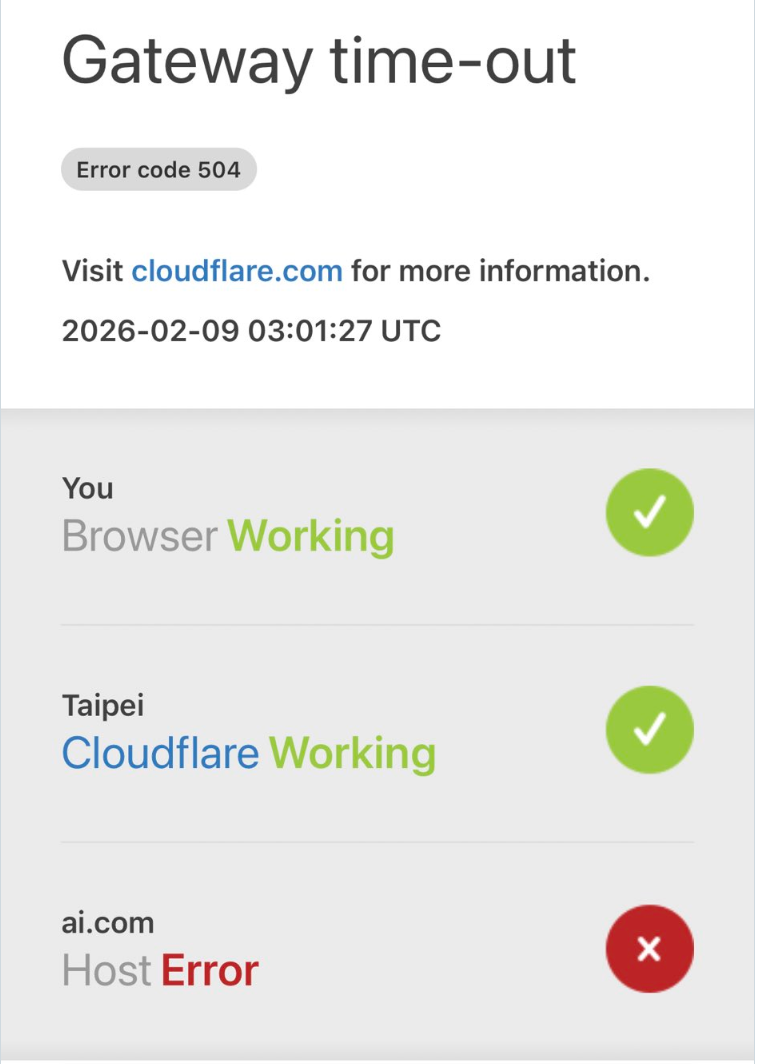
It has to be said, this incident once again confirms that saying—"The whole world is just a slightly larger amateur operation."

As of the time of writing, the ai.com website has returned to normal. Users can抢先 register personal subdomains and AI Agent subdomains to experience the platform's corresponding functions later; as for whether it can deliver on the "autonomous AI Agent" promised in Kris Marszalek's grand vision, the author will reserve judgment for now.

The "Mainstreaming Path" of Crypto Big Shots: Some Buy Houses, Some Buy Power Plants

Another hot topic brought up by the Crypto.com co-founder and CEO spending $70 million on a premium domain is the various paths to mainstreaming that crypto big shots choose for themselves.

Previously, there was Justin Sun spending millions on a lunch with Warren Buffett. Recently, the moves by crypto大佬 have become more diverse:

Aave founder Stani Kulechov bought a mansion worth £22 million (approximately $30 million) in London's Notting Hill last November.

Tether CEO Paolo focuses more on "putting eggs in different baskets." Reliable sources indicate that Tether has invested profits from its stablecoin business into 140 investments covering fields from agriculture to sports and plans to expand its workforce to 450 people; additionally, Tether's gold reserves exceed $23 billion.

Last November, Justin Sun, through his family office SunFund Energy, acquired two small hydropower plants in Norway at once, with a total installed capacity of 86 MW and an annual electricity generation of about 350 GWh, equivalent to the annual electricity consumption of 40,000 European households. In the era of the AI great navigation, the ever-bold Justin Sun chose to hold a "power ticket" to board this era's train.

Regardless of the investment outcomes, cryptocurrency is thereby becoming known to more people through its various forms in news—as a payment currency, a character symbol, an asset class, etc. Perhaps this is an indispensable part of cryptocurrency's journey into the mainstream.

İlgili Sorular

QWho purchased the ai.com domain and for how much?

AKris Marszalek, the co-founder and CEO of Crypto.com, purchased the ai.com domain for $70 million.

QWhat was the initial reaction to the launch of the ai.com platform?

AThe ai.com platform experienced a宕机 (downtime) within 48 hours of its launch, leading to public criticism and being described as a botched 'product launch'.

QWhat was the historical significance of the ai.com domain prior to its sale?

AThe ai.com domain was first registered in May 1993, making it over 30 years old. It was at the center of a bidding war among AI giants like OpenAI and xAI after the rise of ChatGPT, and its pointing address was once changed to Musk's xAI company as a marketing tactic.

QHow did Kris Marszalek justify the enormous cost of the ai.com domain?

AKris Marszalek stated that he believed the domain was crucial for the future trust and recognition of his business. He also mentioned receiving even higher resale offers but chose to keep it, confident in his ability to succeed with it as he did with Crypto.com.

QWhat are some examples of how other crypto billionaires are diversifying their investments?

AOther crypto billionaires are diversifying in various ways: Aave's founder bought a £22 million mansion in London; Tether's CEO invested profits into 140 ventures ranging from agriculture to sports and expanded gold reserves; and Sun Yuchen acquired two small hydropower plants in Norway to secure a 'power ticket' for the AI era.

İlgili Okumalar

The Economics of Human Nature from the Perspective of Black PR: What We See—Public Opinion, Foolish Opinion, or Fishing for Opinion?

This article analyzes the recent wave of negative public opinion targeting Binance through the lens of "black PR"—a form of organized, malicious public relations aimed at destroying a competitor's reputation. The author argues that such campaigns are not random but strategically designed using psychological principles, including the manipulation of crowd psychology (as in *The Crowd: A Study of the Popular Mind*), agenda-setting theory, and the spiral of silence. These tactics are deployed to create an illusion of widespread criticism, suppress opposing voices, and damage trust. The piece outlines a five-stage model of black PR operations: intelligence gathering, covert seeding of narratives, amplification by influencers, bot-driven amplification, and eventual withdrawal to avoid detection. It highlights telltale signs of orchestrated attacks, such as synchronized posting times, fake user accounts with uniform naming patterns, and identical fabricated content (e.g., AI-generated legal letters or withdrawal screenshots). The author presents circumstantial evidence suggesting Binance is currently a target, including analysis of bot accounts and unusual financial transactions—such as a $4,999 transfer from a Binance hot wallet to a social media manipulation platform—that coincide with peak negative coverage. Interestingly, a similar pattern was observed during earlier attacks on OKX. Ultimately, the article calls for an end to such destructive tactics, emphasizing that major exchanges like Binance and OKX—despite their flaws—are pillars of the crypto industry and should not be undermined by coordinated disinformation campaigns.

marsbit54 dk önce

The Economics of Human Nature from the Perspective of Black PR: What We See—Public Opinion, Foolish Opinion, or Fishing for Opinion?

marsbit54 dk önce

Consensus HK Observation: What Consensus Emerged from the First Major Conference of 2026?

Consensus HK 2026 marked a pivotal moment, signaling a shift from crypto’s “wild west” era to a mature phase driven by institutional adoption, AI integration, and sovereign digital currency strategies. Three key themes emerged: First, AI is evolving into true “silicon-based life” with independent financial agency. AI agents are now autonomously transacting, issuing tokens, and even employing humans via blockchain networks like Ethereum and Solana, turning crypto into AI’s native banking system. Second, a global stablecoin war is intensifying. Hong Kong is leading an “onshore counterattack” by phasing out offshore dollar stablecoins like USDT and preparing to launch licensed HKD stablecoins. This reflects broader geopolitical tensions as regions like Europe and Asia push sovereign alternatives to dollar-dominated digital currencies. Third, mass adoption hinges on “invisible” crypto integration. The focus has shifted from infrastructure competition to real-world utility. Applications like seamless payment systems (e.g., PayPal’s PYUSD and Aeon Pay) are embedding crypto silently into everyday use, emphasizing practicality over speculative hype. The takeaway: Crypto is now a fusion of state power, decentralized tech, and AI-driven finance—a more rigorous, system-level transformation with less room for fringe players but greater potential for global impact.

marsbit1 saat önce

Consensus HK Observation: What Consensus Emerged from the First Major Conference of 2026?

marsbit1 saat önce

İşlemler

Spot
Futures
活动图片